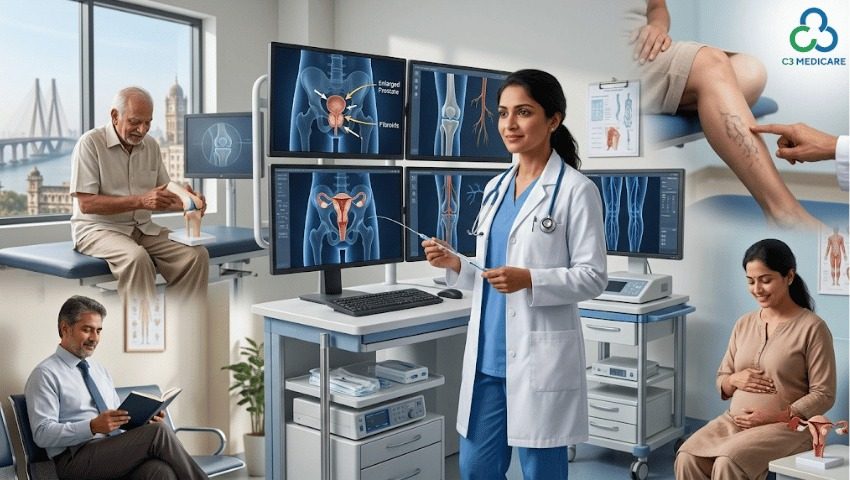
Bulging veins may initially seem like a cosmetic concern, but aching legs, swelling, itching, heaviness or skin changes can make varicose veins much more than an appearance issue.
Some patients delay treatment because they expect vein surgery, hospital admission or a long recovery. In many cases, however, modern varicose veins treatment in Mumbai can include minimally invasive procedures performed through a small access point under imaging guidance.
Treatment depends on which veins are affected, whether the valves are leaking, the severity of symptoms, ultrasound findings and the presence of complications such as skin changes or ulcers.
Varicose veins can be treated with lifestyle measures, compression, endovenous laser treatment, radiofrequency ablation, ultrasound guided foam sclerotherapy or surgery. Duplex ultrasound is usually used to identify abnormal blood flow before treatment. For patients with confirmed truncal vein reflux, current NICE guidance recommends endothermal ablation first when suitable.
What Are Varicose Veins?
Varicose veins are enlarged, twisted veins that most commonly develop in the legs.
Healthy veins contain valves that help blood move back toward the heart. When these valves do not close properly, blood can flow backwards and collect inside the vein.
The increased pressure causes the vein to enlarge, bulge and become more visible.
CIRSE explains that weakening or malfunction of venous valves can lead to pooling of blood and swollen veins, particularly as people become older.
Varicose veins are different from small spider veins, which are usually finer and closer to the surface of the skin.
What Symptoms Can Varicose Veins Cause?
Some people have visible veins without significant symptoms.
Others experience:
- Aching or pain in the legs
- A feeling of heaviness
- Leg swelling
- Burning or throbbing
- Itching
- Muscle cramps
- Tired or uncomfortable legs after standing
- Skin darkening near the ankles
- Dry or inflamed skin
- Open sores or venous ulcers in more advanced cases
Symptoms may become worse after prolonged standing or sitting.
What Causes Varicose Veins?
Varicose veins develop when pressure inside superficial veins increases and the valves responsible for directing blood toward the heart become ineffective.
Age is one recognised factor because vein walls and valves can weaken over time.
Other factors associated with varicose veins can include:
- Family history
- Pregnancy
- Prolonged standing
- Reduced physical activity
- Increased body weight
- Hormonal influences
Not everyone with these factors develops symptomatic varicose veins.
When Do Varicose Veins Need Treatment?
Not every visible vein requires a procedure.
Treatment becomes more important when veins cause symptoms or complications.
Medical assessment may be appropriate if you have:
- Persistent pain or heaviness
- Leg swelling
- Itching or inflammation
- Skin colour changes
- Recurrent vein inflammation
- A venous leg ulcer
- Bleeding from a varicose vein
The NHS advises urgent assessment if a varicose vein is bleeding.
How Are Varicose Veins Diagnosed?
A clinical examination is usually followed by duplex ultrasound when treatment is being considered.
Duplex ultrasound uses sound waves to examine blood flow and determine if valves inside the veins are functioning properly.
The scan can identify:
- Which veins are enlarged
- Where blood is flowing backwards
- The source of venous reflux
- The condition of deeper veins
- Blood clots where present
The NHS notes that duplex ultrasound is commonly used by specialists to confirm varicose veins and plan treatment.
C3 Medicare also describes venous colour Doppler ultrasound as an important investigation for assessing blood flow through the valves and checking for blood clots.
What Treatments Are Available for Varicose Veins?
Treatment should be based on ultrasound findings rather than the appearance of the veins alone.
Options can include conservative care, endovenous treatment, sclerotherapy and surgery.
Lifestyle Measures and Compression Stockings
Exercise, weight management, avoiding long periods of immobility and elevating the legs may help reduce some symptoms.
Compression stockings apply graduated pressure to the legs and can help venous blood return toward the heart.
They may reduce pain or swelling, but they do not repair a faulty vein valve.
NICE states that permanent compression hosiery should generally be considered when interventional treatments are unsuitable rather than automatically used instead of treatment for confirmed truncal reflux.
What Is Endovenous Laser Treatment?
Endovenous laser treatment closes an abnormal vein from inside using controlled heat energy.
A small catheter or laser fibre is inserted into the affected vein under ultrasound guidance.
Local anaesthetic is used around the vein, and laser energy is then delivered as the fibre is withdrawn.
The heat causes the vein wall to close.
Blood naturally redirects through healthier veins.
The NHS describes endothermal ablation as a usual first treatment option for suitable varicose veins and notes that patients can commonly go home the same day.
What Is Radiofrequency Ablation?
Radiofrequency ablation works on a similar principle to laser treatment.
Instead of laser energy, the catheter uses radiofrequency energy to heat the vein wall and close the abnormal vessel.
The procedure is performed under ultrasound guidance and is usually carried out using local anaesthesia.
NICE includes both laser and radiofrequency ablation within the category of endothermal ablation.
The exact technique selected depends on vein anatomy, equipment availability and specialist assessment.
What Is Ultrasound Guided Foam Sclerotherapy?
Foam sclerotherapy uses a chemical solution mixed into a foam that is injected into the abnormal vein.
Ultrasound helps the doctor position the injection accurately.
The foam irritates the inner lining of the vein, causing it to close. The treated vein then becomes scar tissue and blood is redirected into healthier veins.
NICE recommends ultrasound guided foam sclerotherapy when endothermal ablation is not suitable for confirmed truncal reflux.
More than one vein may sometimes be treated during a treatment session.
When Is Surgery Used?
Surgery is still an important option for some patients.
Traditional vein surgery may involve ligation and removal of an abnormal vein.
However, current NICE guidance places surgery after endothermal ablation and ultrasound guided foam sclerotherapy for confirmed truncal reflux when those less invasive treatments are unsuitable.
This does not mean surgery is inappropriate. Some anatomy or clinical situations may make surgery the better option.
What Happens During Minimally Invasive Vein Treatment?
The process depends on the procedure selected.
For laser or radiofrequency treatment, the doctor usually identifies the target vein using ultrasound.
The skin is cleaned and local anaesthetic is given.
A small needle and catheter are introduced into the vein.
Ultrasound is then used to guide the treatment device along the abnormal vein.
The doctor delivers thermal energy to close the vessel.
After treatment, a small dressing is placed over the access area.
Most patients do not need a large incision.
Is General Anaesthesia Required?
Many endovenous treatments do not require general anaesthesia.
The NHS describes endothermal ablation as usually being performed while the patient is awake using local anaesthesia.
Foam sclerotherapy can also be performed using local anaesthesia where needed.
Anaesthesia requirements differ according to the procedure, patient condition and extent of treatment.
Is Varicose Vein Treatment a Day Care Procedure?
Many modern varicose vein procedures can be performed without an overnight hospital stay.
The NHS notes that patients undergoing endothermal ablation or foam sclerotherapy can usually go home on the same day.
C3 Medicare describes endovenous laser treatment as a procedure that may require no admission or bed rest for suitable patients.
Actual discharge timing depends on clinical condition and the treatment performed.
How Long Is Recovery After Varicose Vein Treatment?
Recovery depends on the procedure and how many veins are treated.
After endothermal treatment, some bruising, tenderness or discomfort can occur.
The NHS states that many patients can return to most usual activities quickly after endothermal ablation or foam sclerotherapy. Compression stockings may be advised temporarily.
Patients should follow their doctor’s individual instructions about:
- Walking
- Exercise
- Bathing
- Compression stockings
- Medicines
- Work
- Travel
- Follow up ultrasound
What Are the Possible Benefits of Minimally Invasive Treatment?
For appropriately selected patients, endovenous procedures can offer practical advantages compared with traditional vein surgery.
Potential benefits may include:
- Small access point
- Local anaesthesia for many treatments
- Same day discharge in suitable cases
- Shorter recovery
- Less tissue disruption than vein stripping
- Ultrasound guided targeting
NICE notes that newer endothermal and foam treatments are less invasive than conventional surgery and can allow faster recovery and shorter hospital stays.
These are general benefits and individual recovery varies.
What Are the Risks of Varicose Vein Treatment?
Minimally invasive does not mean risk free.
Possible complications vary according to the treatment and may include:
- Pain or tenderness
- Bruising
- Temporary numbness
- Skin irritation
- Inflammation of the treated vein
- Infection
- Skin pigmentation
- Blood clots
- Nerve irritation
- Vein reopening or recurrence
Rare complications can require additional medical treatment.
The treating specialist should discuss procedure specific risks before treatment.
Laser Treatment Versus Foam Sclerotherapy
Both treatments aim to close abnormal veins, but they use different methods.
Endovenous Laser Treatment
Laser treatment closes the vein using heat delivered through a catheter or fibre.
It is commonly used for larger superficial veins with documented reflux.
Foam Sclerotherapy
Foam sclerotherapy closes the vein using an injected chemical foam.
It may be considered when endothermal treatment is not suitable or for particular patterns of abnormal veins.
NICE recommends endothermal ablation before foam sclerotherapy for suitable patients with truncal reflux.
Treatment still needs to be individualised because anatomy differs from person to person.
Laser Treatment Versus Surgery
Endovenous laser treatment closes an abnormal vein internally without surgically stripping it out.
Traditional surgery physically ties or removes the affected vein.
The main practical differences can include anaesthesia, incision size, recovery requirements and treatment setting.
Neither method is automatically correct for every patient.
Ultrasound findings and specialist assessment should guide treatment selection.
Can Varicose Veins Return After Treatment?
Yes.
Successful treatment can close the targeted abnormal vein, but varicose veins can develop in other veins later.
Venous disease can progress over time, and new valve problems can occur.
Follow up may therefore be advised if symptoms return or new veins become visible.
Maintaining activity, managing weight and following medical advice may help overall venous health, although these measures cannot guarantee that new varicose veins will not develop.
How Much Does Varicose Veins Treatment Cost in Mumbai?
There is no single price that applies to all patients.
Cost can vary according to:
- Number of veins requiring treatment
- Duplex ultrasound findings
- Treatment technique
- Need for laser or radiofrequency equipment
- Sclerotherapy sessions
- Medicines
- Compression stockings
- Facility charges
- Follow up care
Patients should request an individual estimate after clinical and ultrasound assessment.
Insurance coverage also varies. Patients should confirm eligibility and authorisation requirements directly with their insurer or third party administrator.
Varicose Veins Treatment at C3 Medicare in Mumbai
C3 Medicare in Mumbai provides interventional radiology based treatment for varicose veins.
Its published varicose vein information includes sclerotherapy and endovascular ablation among the non surgical treatment options available for suitable patients. C3 Medicare also notes that venous Doppler ultrasound is used to evaluate abnormal blood flow and help plan treatment.
Dr. Rochan Pant has experience in vascular and non vascular interventional radiology and peripheral intervention. C3 Medicare describes his background as including extensive work in image guided vascular procedures.
Patients considering treatment should first have their symptoms, clinical examination and venous ultrasound findings reviewed so that the abnormal veins and source of reflux can be identified.
When Should You Consult an Interventional Radiologist?
A specialist consultation may be appropriate if:
- Varicose veins are painful or uncomfortable
- Your legs become swollen or heavy
- Symptoms worsen after standing
- Skin around the ankle becomes dark or inflamed
- You have a recurrent venous ulcer
- A vein has previously bled
- Compression has not adequately controlled symptoms
- You want to understand minimally invasive treatment options
- You have already had varicose vein treatment and symptoms have returned
A bleeding varicose vein needs prompt medical attention.
Sudden significant leg swelling, severe pain, redness, breathing difficulty or chest pain should also be assessed urgently because these symptoms may indicate another vascular problem.
Conclusion
Modern varicose veins treatment in Mumbai includes several options beyond traditional vein surgery.
Endovenous laser treatment, radiofrequency ablation and ultrasound guided foam sclerotherapy can close abnormal veins using minimally invasive techniques. The correct procedure depends on duplex ultrasound findings, symptoms, vein anatomy and overall health.
Patients who want to understand which treatment may be suitable can consult the interventional radiology team at C3 Medicare in Mumbai for an individual vein assessment and discussion of available treatment options.
FAQs
1. Can varicose veins be treated without surgery?
Yes. Many varicose veins can be treated using minimally invasive procedures such as endovenous laser treatment, radiofrequency ablation or ultrasound guided foam sclerotherapy. Treatment depends on duplex ultrasound findings and the pattern of abnormal blood flow. NICE recommends endothermal ablation first for suitable patients with confirmed truncal reflux.
2. Is laser treatment effective for varicose veins?
Endovenous laser treatment is an established method for closing abnormal superficial veins. It uses heat delivered inside the vein under ultrasound guidance. It is commonly used for suitable patients with venous reflux. Results depend on vein anatomy, disease severity and individual clinical factors.
3. Is varicose vein laser treatment painful?
Local anaesthetic is usually used during endovenous treatment. Patients may experience pressure during treatment and some bruising or tenderness afterward. Pain levels vary between individuals. The NHS notes that endothermal ablation is usually performed while the patient is awake under local anaesthesia.
4. Can I walk after varicose vein treatment?
Walking is commonly encouraged after many minimally invasive vein procedures, and patients can often return to usual activity relatively quickly. Exact activity advice varies according to the treatment performed, so patients should follow the instructions given by their treating specialist.
5. Are compression stockings enough to treat varicose veins?
Compression stockings can reduce symptoms such as swelling and aching, but they do not repair faulty valves. NICE recommends permanent compression hosiery mainly when interventional treatments are unsuitable for patients with confirmed truncal reflux.
6. Which treatment is better, laser or sclerotherapy?
There is no single answer for every patient. For confirmed truncal reflux, NICE recommends endothermal ablation first when suitable and ultrasound guided foam sclerotherapy if endothermal treatment is not appropriate. Smaller or differently located veins may require a different approach.
7. Do varicose veins come back after treatment?
They can. A treated vein may remain closed while new abnormal veins develop elsewhere over time. Recurrence depends on the underlying venous disease, anatomy and progression of valve problems. New symptoms should be reassessed with clinical examination and ultrasound where appropriate.
8. What test is needed before varicose vein treatment?
Duplex ultrasound is usually the main investigation. It shows blood flow direction, valve function and the location of venous reflux. This information allows the specialist to determine which veins require treatment and which technique is most appropriate.