A practical guide to persistent $0 cloud tiers for RAG, semantic search, prototypes, and small AI applications
| What “free forever” means here: a managed cloud plan with no fixed trial expiration, subject to provider limits and future pricing changes. Temporary credits and time-limited trials are not treated as permanent free access. |
Managed vector databases now have useful permanent free tiers
Vector databases have become a standard part of AI application infrastructure. They store embeddings and retrieve semantically related records, which makes them useful for retrieval-augmented generation (RAG), recommendation systems, semantic search, document discovery, support assistants, and other applications that need similarity search.
In 2026, developers no longer have to operate a vector engine themselves just to test an idea. Several managed services provide persistent free plans that remove cluster administration while still giving developers an API, hosted storage, indexing, filtering, and vector search. The important detail is that every free tier has boundaries: storage, memory, object counts, collections, operations, regions, availability guarantees, or inactivity policies can limit what should be deployed on it.
The options below are useful starting points for development and small workloads. They are presented as practical choices rather than a ranking, because the right service depends on the application architecture, expected vector count, query pattern, metadata needs, and eventual production requirements.
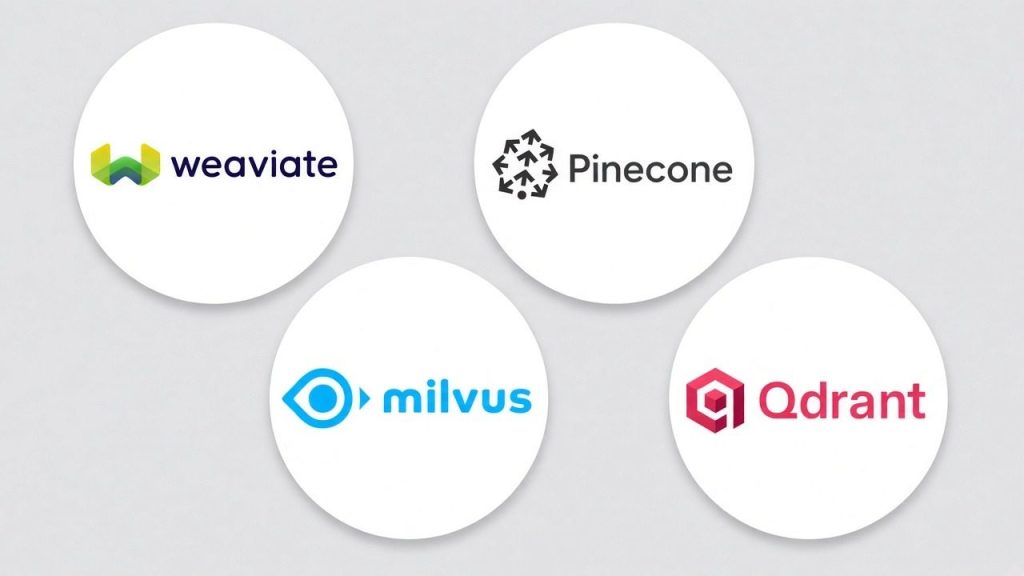
Weaviate Cloud provides an always-free managed database for compact AI projects
Weaviate Cloud now offers an Always Free plan at $0 per month with no credit card required. The plan includes one managed cluster per user, up to 100,000 objects, 1 GB of memory, 10 GB of disk, one collection, and up to three tenants. The free plan also includes limited access to Weaviate-hosted embeddings and its Query Agent.
For developers, this creates a straightforward environment for a RAG prototype, a small knowledge base, semantic product discovery, or an internal search tool. Weaviate supports vector and hybrid retrieval as part of the database, so an application can combine semantic similarity with keyword-oriented retrieval without maintaining a separate search system for an early-stage project.
The free cluster is intended for exploration rather than demanding production workloads. It does not include the high-availability and replication features available on paid plans, and its collection and object limits matter when an application grows. Still, its explicit “always free” status makes it suitable for projects that need a persistent managed environment rather than a short sandbox.
Qdrant Cloud offers a free-forever cluster with fixed compute and storage
Qdrant Cloud labels its managed Free Tier as “Free forever.” The free cluster is a single-node deployment with 0.5 vCPU, 1 GB of RAM, and 4 GB of disk. Qdrant also includes free cloud inference with selected models, while larger managed configurations move to usage-based paid tiers.
This resource-based model is useful for developers who want to understand the actual environment available to their application. A developer can use the cluster for vector search, metadata filtering, RAG experiments, agent memory, or semantic search while working within a defined RAM and disk envelope. Qdrant also has an open-source edition, which can make local development and later deployment choices easier to explore.
The free tier is not designed for high availability, large datasets, or production workloads that require stronger operational guarantees. Once vector collections exceed the available memory or storage, an upgrade is necessary. For prototypes and modest personal projects, however, the managed cluster can remain available without a monthly subscription.
Zilliz Cloud gives developers a managed route into the Milvus ecosystem
Zilliz Cloud is the managed service built around Milvus and has offered a free serverless path for developers. Its free offering is intended for development and small vector workloads, allowing teams to use Milvus-style vector search without provisioning or maintaining their own Milvus infrastructure.
This is relevant for developers who want to prototype RAG pipelines, similarity search, multimodal retrieval, or embedding-based applications while staying close to the Milvus ecosystem. The managed model handles infrastructure concerns such as service operation and scaling mechanics, allowing application code to focus on ingestion, indexing, metadata, and retrieval logic.
Free-plan quotas and serverless allowances can change, so developers should check the current Zilliz pricing page before designing around a specific vector count or storage allowance. The permanent free entry point is useful for experimentation, but production sizing should be based on current workload estimates rather than assuming that free quotas will cover future growth.
Pinecone can be used through its managed free entry tier for development workloads
Pinecone is a fully managed vector database designed around hosted vector search and developer APIs. In 2026, its free entry option gives developers a way to create indexes and test semantic retrieval without first managing servers, shards, or a self-hosted database installation.
The service fits projects where a developer wants a cloud-native vector API for RAG, semantic search, recommendations, or retrieval components inside an AI application. Because the operational layer is managed, teams can concentrate on chunking strategy, embeddings, namespaces, metadata filters, and retrieval quality rather than database maintenance.
Pinecone has changed plan names, quotas, and pricing structures over time, so the exact free allowance should be confirmed before launch. Developers should also separate an ongoing free tier from promotional credits or startup-program benefits. That distinction matters when estimating whether a prototype can remain at $0 after initial development.
Astra DB Serverless supports vector workloads through a broader managed data platform
DataStax Astra DB Serverless provides vector capabilities as part of a managed database platform rather than as a vector-only service. Its free usage model can support small applications that need vector search together with conventional application data and APIs, making it relevant when embeddings are only one part of the data layer.
Developers can use this model for RAG applications, knowledge retrieval, conversational applications, and other systems where vector similarity is combined with structured records. A serverless approach can also be convenient during early development because infrastructure capacity does not have to be manually provisioned for every experiment.
Astra DB pricing has used recurring free allowances and credits, so developers should verify the current monthly allowance and vector-related limits before depending on it as a permanent zero-cost deployment. It is especially important to distinguish recurring free usage from one-time promotional credit when comparing it with plans explicitly labeled “free forever.”
What developers should check before choosing a free tier
A free managed database can remove infrastructure work, but the database limit is only one part of the cost of an AI application. Embedding generation, reranking, language-model calls, data transfer, backups, and application hosting may have separate charges. A project that keeps its vector database at $0 can still create costs elsewhere in the stack.
Developers should also look at what happens when a free project becomes inactive, exceeds a quota, or needs production reliability. High availability, backups, private networking, larger regions, enterprise authentication, and formal service-level agreements are commonly reserved for paid plans. A free tier is therefore most useful when the application has a clear path for upgrading without redesigning its retrieval layer.
For a small RAG demo, portfolio project, learning environment, or internal prototype, permanent managed free tiers can now provide enough infrastructure to build and test real retrieval workflows. The practical choice is to match the service limits to the project, keep an eye on usage, and re-check provider pricing before moving a workload into production.
Sources and verification notes
• Weaviate Cloud Pricing — weaviate.io/pricing (verified October 2026).
• Qdrant Cloud Pricing — qdrant.tech/pricing (verified October 2026).