
E-commerce businesses often sell through multiple online marketplaces while using different accounting applications to manage their books. Some businesses prefer TallyPrime, others use BUSY, while many modern businesses and accounting teams work with Zoho Books.
Although these accounting applications serve similar business needs, marketplace report processing can become complicated when every platform has its own reporting format and accounting requirements.
For sellers operating on Amazon, Flipkart, Meesho and other marketplaces, the real challenge is not just recording sales. It is converting marketplace transactions into organised, reviewable accounting data that can be used across different accounting systems.
A unified accounting workflow can help simplify this process.
Why Marketplace Accounting Becomes Complicated
Every marketplace generates different types of business and financial reports. These may include:
- Sales and order details
- Settlement and payment statements
- Returns and refund transactions
- Marketplace commission and service charges
- Shipping and fulfilment fees
- GST-related transaction details
- TCS and other applicable tax deductions
The structure of these reports can vary between marketplaces. Even when two reports contain similar information, their column names, transaction references and formats may differ.
When sellers process these files separately, accounting teams often end up maintaining multiple Excel workbooks, macros and manual data-conversion processes.
This creates additional work and makes it harder to maintain a consistent accounting procedure.
The Challenge of Using Different Accounting Applications
Businesses do not necessarily use the same accounting software.
For example:
- A small marketplace seller may use TallyPrime.
- A growing business may manage its books through BUSY.
- An accounting service provider may use Zoho Books for several clients.
- A CA firm may handle businesses that use different accounting applications.
The challenge increases when an accountant or bookkeeper manages multiple clients and each client follows a different accounting setup.
Without a common report-processing workflow, the same marketplace information may need to be handled differently for every accounting application.
A more organised approach is to separate marketplace report processing from the final accounting application.
What Is a Unified Marketplace Accounting Workflow?
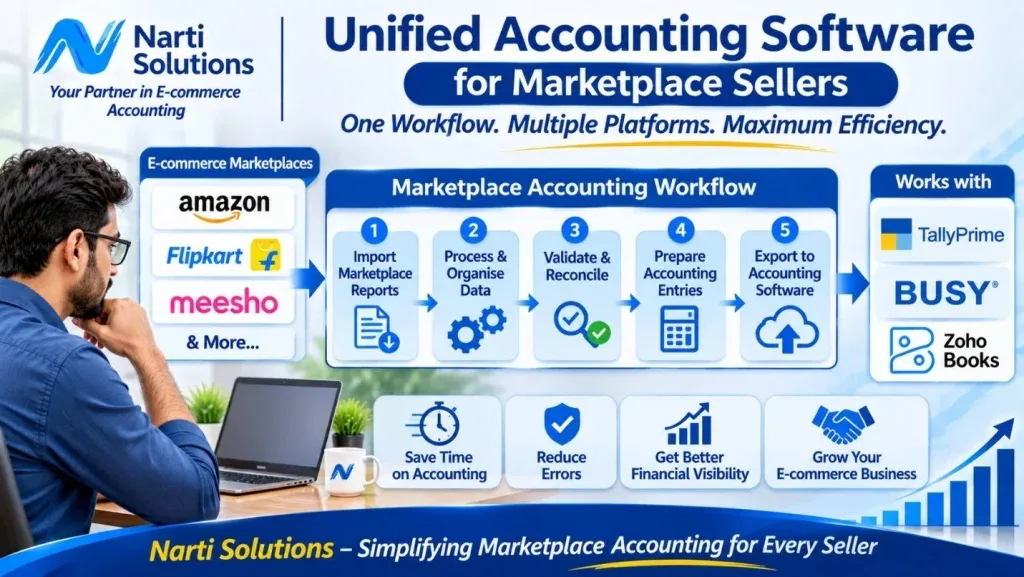
A unified marketplace accounting workflow uses a consistent process to collect, organise, validate and prepare marketplace transactions before they are transferred into the accounting software.
Instead of building a completely separate process for every accounting application, businesses can follow common processing steps and use the appropriate output method for their accounting system.
A typical workflow has five stages.
1. Collect Marketplace Reports
The first stage is collecting supported reports from the marketplaces where the business sells its products.
These may include Amazon, Flipkart, Meesho and other supported e-commerce platforms.
The reports provide information about sales, returns, fees, settlements and other financial transactions.
2. Process and Organise Transactions
The downloaded files need to be processed into a consistent structure.
Important information may include:
- Order and invoice references
- Product and transaction details
- Taxable values and GST amounts
- Marketplace charges
- Return and refund values
- Settlement references
This makes it easier to review information across different marketplace report formats.
3. Validate and Review the Data
Before creating accounting entries, businesses should review the processed information.
Validation can help identify potential issues such as:
- Missing transaction references
- Duplicate records
- Incorrect or incomplete values
- Unmatched settlement transactions
- Differences between sales and return reports
The objective is to identify issues before the data reaches the accounting system.
4. Prepare Accounting-Ready Data
After processing and validation, the information can be mapped to the required accounting structure.
This may include sales accounts, sales return ledgers, marketplace expense accounts, tax ledgers and settlement-related accounts.
The exact mapping depends on the business, marketplace and accounting configuration.
5. Transfer Data to the Accounting Application
The final stage is preparing the data for the selected accounting software.
A common processing workflow can support different output requirements without forcing every business to change its existing accounting application.
How Different Accounting Applications Fit into the Workflow
TallyPrime
TallyPrime users can manage marketplace accounting through suitable sales, return, expense, tax and settlement-related ledgers.
Depending on the configured workflow, accounting-ready transactions can be prepared for supported XML voucher imports.
BUSY
BUSY users can organise marketplace sales, credit notes, expenses and settlement adjustments through the appropriate account and voucher structures.
The processed data can be prepared for supported import or integration methods.
Zoho Books
Zoho Books users can use available import and API workflows to organise marketplace transactions.
Sales, credit notes, expenses and payment-related entries should be mapped to the correct accounts.
The accounting applications remain different, but the upstream process of collecting and organising marketplace reports can follow a consistent structure.
Why This Approach Is Useful for CA Firms and Bookkeepers
The need for a unified workflow becomes more important when accounting professionals manage several businesses.
A CA firm may work with one client using TallyPrime, another using BUSY and a third using Zoho Books.
If each client requires a completely separate manual report-processing procedure, the accounting team spends additional time handling formats rather than reviewing financial information.
A common processing approach can help accounting professionals:
- Standardise marketplace report handling.
- Reduce repetitive Excel operations.
- Maintain consistent validation procedures.
- Organise client-wise accounting data.
- Prepare records for different accounting applications.
- Review marketplace settlements more systematically.
The final accounting configuration and tax treatment should still be reviewed for each client.
How Narti Solutions Supports a Unified Workflow
Narti Solutions is designed to help marketplace sellers, accountants, bookkeepers and CA firms organise e-commerce accounting processes.
The platform focuses on processing supported marketplace reports and preparing accounting-ready data for different accounting applications.
Its workflow includes:
Marketplace report import: Import supported reports from e-commerce platforms.
Data processing: Organise sales, returns, fees, settlements and other transaction information.
Validation: Identify potential inconsistencies and missing information for review.
Accounting preparation: Map processed information into relevant accounting fields.
Accounting software output: Prepare data for supported workflows involving TallyPrime, BUSY and Zoho Books.
AI-assisted data processing can also help organise information and highlight potential inconsistencies. Final accounting entries and tax treatment should be verified by the responsible accounting professional.
Should Businesses Change Their Accounting Software?
Not necessarily.
A business that already uses TallyPrime, BUSY or Zoho Books may have established accounting practices, trained employees and historical financial records in that application.
Changing accounting software only to solve marketplace report-processing problems may introduce unnecessary disruption.
A more practical approach can be to improve the workflow that connects marketplace reports with the existing accounting application.
This allows businesses to retain their preferred accounting system while improving how marketplace information is processed.
Conclusion
As e-commerce businesses expand across multiple marketplaces, accounting workflows need to become more organised and scalable.
Managing different marketplace report formats alongside different accounting applications can create repetitive work for sellers and accounting professionals.
A unified marketplace accounting workflow separates report processing from the final accounting application. This makes it easier to organise transactions, validate information and prepare accounting-ready data for TallyPrime, BUSY and Zoho Books.
Narti Solutions aims to support this approach by helping businesses simplify marketplace report processing without requiring them to abandon their existing accounting software.
Explore Narti Solutions
Website: https://nartisolutions.com/